
A Beginner’s Guide to Choosing Restaurant POS Software in UAE
Running a food business in the UAE is exciting, but it comes with its own set of operational headaches. Long queues, order mix-ups, manual billing errors, stock running out mid-service, or staff struggling to keep up during peak hours. These are not rare problems. They are the everyday reality for restaurant owners who have not yet invested in the right technology. If you are at the stage where you are evaluating your options, a good starting point is understanding what a modern billing solution for restaurants actually does, what features matter, and how to avoid paying for things you do not need.
Why UAE Restaurants Have Specific Requirements
The UAE food and beverage market is one of the most competitive in the world. Dubai and Abu Dhabi alone have thousands of licensed food establishments, ranging from quick service counters and cloud kitchens to fine dining restaurants and multi-branch cafe chains. This density means customer expectations are high and operational margins are tight.
On top of that, UAE restaurants must deal with VAT compliance. Since the introduction of 5% VAT, every invoice needs to be accurate and properly formatted for Federal Tax Authority requirements. A billing system that does not handle VAT correctly is not just an inconvenience; it is a compliance risk. Any point of sale system you consider should produce FTA-compliant receipts and maintain clean transaction records for audit purposes.
Multilingual operations are another local reality. Many restaurants in the UAE serve a mix of Arabic-speaking, English-speaking, and South Asian customers, and kitchen staff often come from a variety of backgrounds. A system that supports Arabic display and can print kitchen order tickets in a language the kitchen team understands reduces errors significantly.
Core Features to Look For
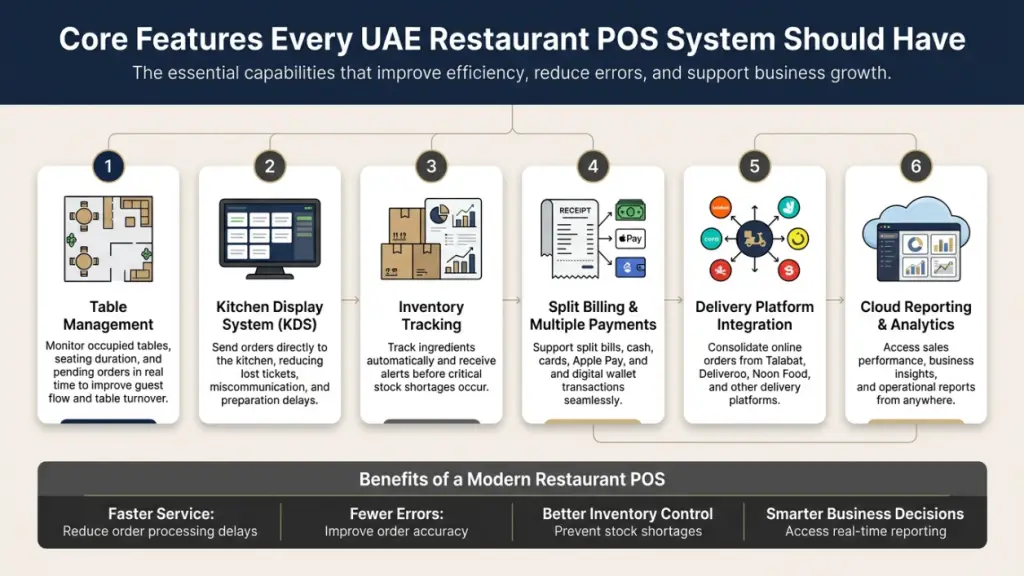
Before you start comparing vendors, it helps to know which features are genuinely essential versus which ones are nice to have on a brochure.
Table management is critical for sit-down restaurants. You need to see which tables are occupied, how long they have been seated, and which orders are pending. A visual floor map with live status updates saves your front-of-house team a lot of back-and-forth. Effective table management also helps staff turn tables efficiently, reduce wait times, and provide a smoother dining experience for guests.
Kitchen display systems (KDS) replace the old paper ticket system. Orders placed at the counter or via table service show up directly on a screen in the kitchen. This eliminates lost tickets, reduces verbal miscommunication, and speeds up preparation time.
Inventory tracking at the ingredient level is something many beginners overlook. Basic systems track stock by item, but smarter systems deduct ingredients automatically as orders are placed. When your chicken stock is getting low, the system flags it before you run out during dinner service.
Split billing and multiple payment methods matter more in UAE than in many other markets. Groups dining out often want to split bills, and customers use a mix of cash, cards, Apple Pay, and now various digital wallets. Your system should handle all of these without friction.
Delivery integration is no longer optional. Aggregators like Talabat, Noon Food, and Deliveroo are a significant revenue channel for most UAE food businesses. A POS that integrates with these platforms, or at least consolidates orders into a single dashboard, saves your staff from juggling multiple tablets.
Cloud-based reporting gives you access to sales data, top-selling items, peak hours, and staff performance from your phone or laptop. For multi-branch owners, this is how you keep oversight without being physically present at every location.
Cloud vs. On-Premise: Which Makes Sense for You?
This is a common question, and the honest answer is: it depends on your setup and your risk tolerance.
| Feature | Cloud-Based POS | On-Premise POS |
| Internet dependency | Requires stable connection | Works fully offline |
| Data access | Anywhere, any device | Local network only |
| Software updates | Automatic | Manual / vendor-managed |
| Upfront cost | Lower (subscription model) | Higher (one-time license) |
| Data backup | Automatic cloud backup | Manual or local backup |
| Ideal for | Multi-branch, delivery-heavy, remote owners | High-volume single outlet, low connectivity areas |
Most newer UAE restaurant owners lean toward cloud-based systems because of the flexibility, easier updates, and the ability to monitor operations remotely. However, if your location has unreliable internet connectivity, or you run a very high-volume kitchen where even a 30-second system lag creates problems, an on-premise or hybrid system with offline capability may be worth the extra upfront cost.
Questions to Ask Before Signing a Contract
Do not let a sales demo dazzle you into a decision you will regret. Here are practical questions worth asking every vendor:
What happens when the internet goes down? A good system should have offline mode so that you can keep taking orders and billing customers, with data syncing once connectivity is restored.
Is the system VAT-compliant and FTA-ready? Ask for a sample receipt and verify that it meets FTA requirements, including the proper tax invoice format, TRN display, and line-item VAT breakdown.
What does the setup and training process look like? Software that your staff cannot learn quickly is software that will cause problems during service. Ask about onboarding time and whether training is included.
Is there local support in the UAE? This is often underestimated. When something goes wrong on a Friday evening during your busiest dinner shift, you need someone you can call in your time zone, not a support ticket that gets answered 48 hours later.
Can it scale with my business? If you plan to open a second branch in the next year or two, your system should support multi-branch business management without requiring you to switch platforms entirely.
What Beginners Often Get Wrong
The biggest mistake first-time buyers make is choosing based on price alone. A cheaper system that lacks inventory tracking or breaks down under high transaction volume will cost you more in lost sales and staff frustration than you saved upfront.
The second mistake is underestimating staff resistance. Even excellent software fails if the team is not trained properly or if the interface is confusing during a rush. Always ask for a trial period or demo, and involve your floor manager and cashier in the evaluation, not just yourself.
The third mistake is ignoring integration needs. If you already use accounting software, an online ordering platform, or a customer loyalty program, your POS needs to connect with these tools. Siloed systems create double data entry, which is exactly what you were trying to avoid.
Making Your Final Decision
Shortlist two or three systems based on the features above, then request a live demo with your actual menu loaded in. Watch how quickly an order can be placed, modified, and billed. Check how the kitchen display looks. Ask to see a sample end-of-day report. The system that feels intuitive in the demo will feel even more natural after a week of actual use.
Local providers that understand the UAE market, speak your language, and can offer on-ground support often have a real advantage over global platforms that were not built with UAE VAT compliance or Arabic support in mind. MultiTech POS, for instance, is specifically built for UAE businesses and covers the full F&B spectrum from fast food counters to fine dining setups.
If you are still figuring out where to start, exploring the range of POS solutions in UAE available for different business types and sizes can help you narrow down your requirements before you talk to any vendor. Getting clarity on your own needs first makes every vendor conversation more productive.
Frequently Asked Questions
Q: Do I need a POS system if I run a small cafe with just a few tables?
Yes, even small cafes benefit from a POS system. It speeds up billing, tracks your daily sales accurately, and helps you monitor which items sell best. Many systems are priced affordably for small setups with monthly subscription options.
Q: Is cloud-based POS safe for storing my restaurant’s sales data?
Reputable cloud POS providers use encrypted servers and regular backups, which is often more secure than data stored on a local machine that could be lost or damaged. Always check the provider’s data security policy before committing.
Q: Can a POS system help with VAT filing in the UAE?
A good POS system will not file your VAT return for you, but it will produce accurate, FTA-compliant invoices and generate sales reports that make the filing process much easier for your accountant.
Q: What is the difference between a POS system and a restaurant management system?
A POS handles the transaction layer, including order taking, billing, and payment. A restaurant management system is broader and may include staff scheduling, inventory purchasing, supplier management, and financial reporting. Many modern POS platforms bundle both into one solution.
Q: How long does it take to set up and go live with a new POS system?
For a single-outlet restaurant, setup typically takes one to three days, including hardware installation, menu configuration, and basic staff training. More complex setups with multiple branches or integrations may take longer.
